
Trends
The Health of US Healthcare
A recent report on the quality of US Healthcare doesn't put us in first place, despite spending far more on healthcare than other nations. Why is that? (Preview)
What’s the problem?
Understanding the problem
- What's the problem?
- Understanding the problem
- Truth, the whole Truth, and Nothing but the Truth
- Hopes for the future
- References
What’s the problem?
Here’s the explanation that was offered [1]: “The goal of healthcare is to get everyone covered, at the lowest possible cost, with the highest possible quality. But in the United States, there is another element in the equations that mucks up the outcome. Our system seeks to get everyone covered, at the lowest possible cost, with the highest possible quality, while generating the maximum possible profits. Within that context, the trade-offs and outcomes all seem to benefit the last goal, and so we tolerate 45 million uninsured Americans, unbelievably high prices, and a fractured system that lacks the proper incentives to deliver high-quality care.”
In the US, only the VA system ranks high in quality, choice, and responsiveness. But the VA is “socialized medicine,” a naughty word that we dare not even mention in public nor in politics, even though that approach has been demonstrated to be the most effective in the US marketplace.
A much more detailed accounting of the problems with the US healthcare system has been provided in the book “Money-Driven Medicine” [2]. By business standards, US healthcare is wildly successful. Everyone is making money! Only the patients are unhappy because of the high cost and low quality. As one US healthcare economist has been quoted as sayingt: “Bad quality is good for business” [3]. Bad quality means more business, doing things over, or doing things to take care of complications and side-effects, or doing things to correct the harm done earlier.
“What if medical care came with a 90-day warranty?” That’s the opening line in a recent newspaper article “In push for better care, a heart-surgery warranty” which made the front page of The New York Times [4]. Proving a warranty would mean that complications, side-effects, and poor outcome would be covered without any additional payment. As reported, the Geisinger Health Systems group is the first to offer a warranty on healthcare services. “…Geisinger’s effort is noteworthy as a distinct departure from the typical medical reimbursement system in this country, under which doctors and hospitals are paid mainly for delivering more care – not necessarily better care.” [4]
Understanding the problem
Dilbert recently clarified the priorities in the business model during a conversation with management, which went as follows:
Manager: “Remember, quality is our top priority.”
Dilbert: “Question: Is it more important than safety?
Manager: “Ooh… I forgot about that one.”
Dilbert: “Is quality more important than obeying the law?”
Manager: “Well…, probably not.”
Dilbert “If we could maximize shareholder value by selling lower quality items, wouldn’t we have a fiduciary responsibility to do it?
Manager: “I’m sure quality is in the top four.”
Dilbert: “What if we had to lie to achieve quality?”
This whole scenario has happened and continues to happen in healthcare organizations and laboratories in the US today! The reality today is represented by CQI - Continuous Quality Issues, not Continuous Quality Improvement. Quality is important, but patient safety is the new movement in healthcare. Quality and safety are important, but obeying the law, i.e., compliance, is more important. Quality and safety and compliance are important, but making money is even more important!
In spite of all the quality issues in healthcare, we continue to believe that the US healthcare is the best that money can buy! Of course, a lot of people don’t have the money to buy good healthcare, but those of us who are fortunate know we have the best access, choice, and responsive healthcare available, right?
 We invite you to read the rest of this article
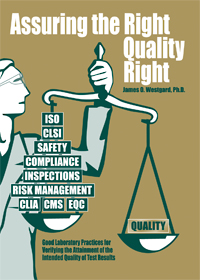
Updated and expanded coverage of these topics can be found in Assuring the Right Quality Right, available in our online store. You can also download the Table of Contents and additional chapters here.
Also, you can access similar materials online on these topics by enrolling in the Management and Design of Analytical Quality Systems course course.