
Basic QC Practices
QC: Levey-Jennings: Answers
Patricia L. Barry, BS, MT(ASCP)
Answers to the Levey-Jennings Control Chart lesson exercise.
Answers for this exercise
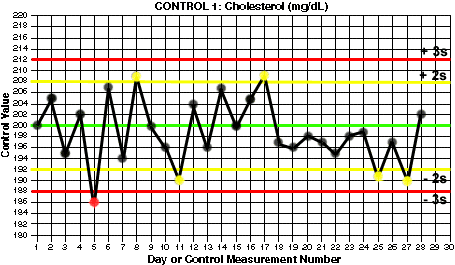
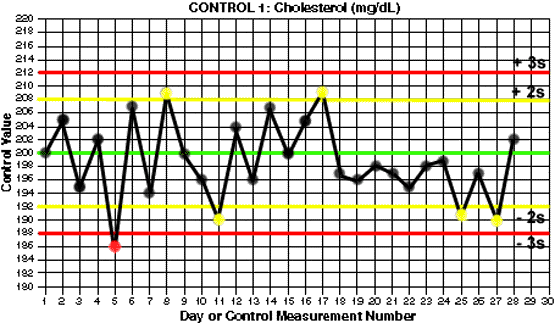
Click here if you want to print a larger version of this chart separately.
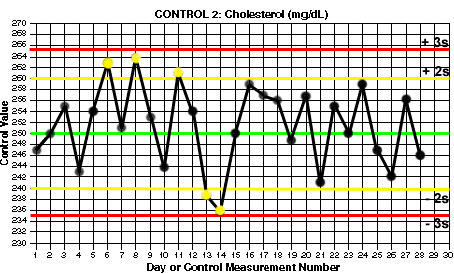
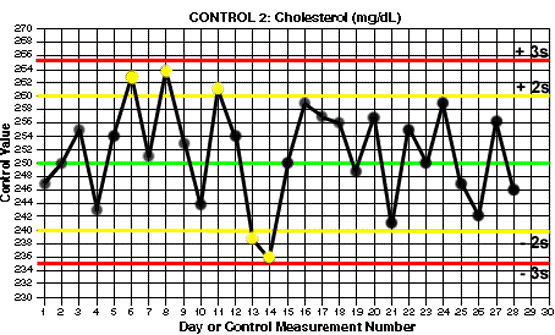
Click here if you want to print a larger version of this chart separately.
Cholesterol example where: |
||||||
| Day | Control 1 Value |
Control 2 Value |
12s Rule Violation |
13s Rule Violation |
Accept(A), Warning (W), or Reject(R)? |
Comments |
| 1 | 200 | 247 | A | |||
| 2 | 205 | 250 | A | |||
| 3 | 195 | 255 | A | |||
| 4 | 202 | 243 | A | |||
| 5 | 186 | 254 | -2s | - 3s | R | |
| 6 | 207 | 263 | + 2s | W(A) | ||
| 7 | 194 | 251 | A | |||
| 8 | 209 | 264 | + 2s twice | R | Both exceed + 2s. | |
| 9 | 200 | 253 | A | |||
| 10 | 196 | 244 | A | |||
| 11 | 190 | 261 | + 2s and - 2s | R | both exceed 2s in opposite directions. |
|
| 12 | 204 | 254 | A | |||
| 13 | 196 | 239 | - 2s | W(A) | ||
| 14 | 207 | 236 | - 2s | R | 2 days in a row exceeding - 2s. |
|
| 15 | 200 | 250 | A | |||
| 16 | 205 | 259 | A | |||
| 17 | 209 | 257 | + 2s | W(A) | ||
| 18 | 197 | 256 | A | |||
| 19 | 196 | 249 | A | |||
| 20 | 198 | 257 | A | |||
| 21 | 197 | 241 | A | |||
| 22 | 195 | 255 | A | |||
| 23 | 198 | 250 | A | |||
| 24 | 199 | 259 | A | |||
| 25 | 191 | 247 | - 2s | W(A) | Negative shift. | |
| 26 | 197 | 242 | A | |||
| 27 | 190 | 256 | - 2s | W(A) | Follow to see if negative shift continues or worsens. |
|
| 28 | 202 | 246 | A | |||
Interpretation of control results - with 12s and 13s rules
Use of a 12s rule as a strict rejection rule would result in rejecting runs on days 5, 6, 8, 11, 13, 14, 17, 25, and 27, for a total of 9 runs, as shown by the check marks in the column for 12s rule violations.
Use of a 13s rejection rule would lead to rejection of only one run on day 5, as shown by the single check mark in the column for 13s rule violations.
It makes a big difference what control rule is being applied -- 9 rejections vs 1 rejection!
What if different control rules were used?
Given that the 12s rule is known to cause a high level of false alarms or false rejections, it might be better to interpret the data more carefully, in effect applying additional control rules, such as the 22s and R4s rules:
- 22s indicates a rejection when two consecutive control values exceed the same mean +2s limit or the same mean -2s control limit; this rule is sensitive to shifts in the mean of the distribution, therefore it is a good indicator of increases in systematic error or changes in the accuracy of the method.
- R4s indicates a rejection when one control measurement in a run exceeds a +2s control limit and another exceeds a -2s control limit. This "range" rule is sensitive to changes in the width of the distribution, therefore it is a good indicate of increases in random error or changes in the precision of the method.
Use of the 13s rule together with the 22s and R4s rules leads to a multirule QC procedure in which multiple decision criteria are applied simultaneously. If any single control rule is violated, the run is rejected. Here's how the 13s/22s/R4s multirule procedure would be interpreted for this example set of control results:
- Day 5. The value for Control 1 exceeds a -3s control limit, which is a good indication that there is a problem with the method. Stop, reject the run, trouble-shoot the method, fix the cause of the problem, then restart the method and reanalyze the patient specimens.
- Day 6. The value for Control 2 exceeds a +2s control limit, but doesn't exceed a 3s limit. There might be a problem, but this might also be a false rejection. If a 12s rule were strictly applied, the run would be rejected. However, because the value for Control 1 is okay, it is likely that this is a false rejection. Accept the run.
- Day 8. Both the values for Control 1 and Control 2 exceed their respective +2s control limits. It is rare to see two values in a row exceed the same +2s limit, therefore this occurrence indicates a problem with the method. Note that this interpretation applies the 22s control rule, i.e., 2 values in a row exceeding the same control limit. Since both controls are out in the same direction, it is likely there is a systematic error (or problem with the accuracy of the method). Stop, reject the run, trouble-shoot the method, fix the cause of the problem, then restart the method and reanalyze the patient specimens.
- Day 11. Both control values exceed 2s control limits, but one is positive and one is negative. It is a rare occurrence and most likely there is a problem with the method. Since the two controls are out in opposite directions, it is likely that there is a random error (or problem with the precision of the method). Note that this interpretation applies the R4s rule, i.e., the range of the control values exceeds 4s. Stop, reject the run, trouble- shoot the method, fix the cause of the problem, then restart the method and reanalyze the patient specimens.
- Day 13. The value for Control 2 is outside the low end of the 2s range. There is a warning of a possible problem, but this might also be a false rejection. Accept this run because none of the rejection rules are violated.
- Day 14. The value for Control 2 is again outside the low end of the 2s range. This makes 2 days or 2 runs in a row, which is unusual. Since both values for Control 2 are out in the same direction, it is likely there is a systematic error (or problem with the accuracy of the method). Stop, reject the run, trouble-shoot the method, fix the cause of the problem, then restart the method and reanalyze the patient specimens.
- Day 17. Control 1 exceeds the +2s control limit. There might be a problem, but this might also be a false rejection. If a 12s rule were strictly applied, the run would be rejected. However, because the value for Control 2 is okay, it is likely that this is a false rejection. Accept the run.
- Day 25. Control 1 exceeds the -2s control limit. There might be a problem, but this might also be a false rejection. If a 12s rule were strictly applied, the run would be rejected. However, because the value for Control 2 is okay, it is likely that this is a false rejection. Accept the run.
- Day 27. Control 1 exceeds the -2s control limit. There might be a problem, but this might also be a false rejection. If a 12s rule were strickly applied, the run would be rejected. However, because the value for Control 2 is okay, it is likely that this is a false rejection. Accept the run.