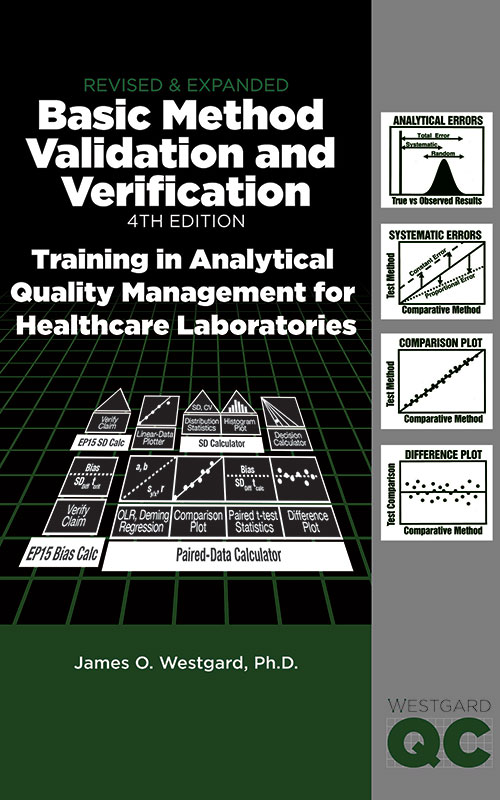
Basic Method Validation Second Edition 2003, 292 pages $60 list price
Authors: James O. Westgard, Ph.D. with contributions from: Elsa F. Quam, BS MT(ASCP) Patricia L. Barry, BS MT(ASCP) Sharon S. Ehrmeyer, Ph.D.
Experiments covered:
Contents:
With the best of the first edition and the new material from the second edition, Basic Method Validation teaches you how to:
Basic Method Validation addresses healthcare professionals who perform laboratory tests in central laboratories, clinic or outpatient laboratories, and point-of-care settings. This concise, easy-to-read, 292-page manual contains a comprehensive introduction to method validation in the laboratory, from the conceptual idea of method validation to the bench-level specifics of planning an experiment:
Basic Method Validation is part of a trilogy of back to basics books that deal with analytical quality management. The other two books are Basic QC Practices and Basic Planning for Quality. When I teach these materials to students, I start with method validation because it introduces the basic concepts of analytical performance and the experimental and statistical techniques needed to describe performance in quantitative terms. Those concepts carry through into the practice of QC, including the selection of optimal QC designs by careful planning for quality. Method validation has actually become more important with publication of the Final CLIA Rule, which adds a requirement that laboratories must validate all non-waived methods introduced after April 24, 2003. Previously, moderately complex methods did not need to be validated. Now moderately and highly complex methods are combined into a category of non-waived methods that must be validated by the laboratory. The changes in CLIA made it imperative to update this book. The 2nd edition includes the following new, revised, and reorganized materials: Revised chapter on regulations that reflects the Final CLIA Rule that was published in January 2003. Revised material on reportable range that includes the CAPs new concepts of analytical measurement range (AMR) and clinical reportable range (CRR). New chapter on statistical sense, sensitivity, and significance to provide a better understanding of the behavior of different statistics in response to different types of analytical errors. Revised Method Decision Chart that includes the Six Sigma goal for world class quality. Additional discussion of Deming and Passing-Bablock regression. New Internet calculators that perform Deming and Passing-Bablock regression. Reorganization of some of the statistical materials to provide successive "doses" at the right times. New chapter that discusses the new ISO approach of characterizing analytical performance as uncertainty rather than the traditional characterization in terms of analytical errors. We hope that readers of the 2nd edition will find Basic Method Validation even more useful and valuable than the 1st edition.
Basic Method Validation is part of a trilogy of back to basics books that deal with analytical quality management. The other two books are Basic QC Practices and Basic Planning for Quality. When I teach these materials to students, I start with method validation because it introduces the basic concepts of analytical performance and the experimental and statistical techniques needed to describe performance in quantitative terms. Those concepts carry through into the practice of QC, including the selection of optimal QC designs by careful planning for quality.
Method validation has actually become more important with publication of the Final CLIA Rule, which adds a requirement that laboratories must validate all non-waived methods introduced after April 24, 2003. Previously, moderately complex methods did not need to be validated. Now moderately and highly complex methods are combined into a category of non-waived methods that must be validated by the laboratory.
The changes in CLIA made it imperative to update this book. The 2nd edition includes the following new, revised, and reorganized materials:
We hope that readers of the 2nd edition will find Basic Method Validation even more useful and valuable than the 1st edition.
Back to top
Born from an Internet training course, Westgard's clear writing merges with on-online lessons and analysis tools to make this text an ideal learning tool for laboratory consultants, managers, or current and future generations of clinical laboratory scientists. This practical guide to method validations stresses quality management and error assessment throughout its 18 chapters and 3 appendices. Each chapter begins with Objectives, Lesson Materials, and Things to Do. Printed and on-line references and self-assessment questions appear at the end of each chapter. The first 3 chapters characterize quality in the laboratory by showing ways to improve and guide the quality management process, illustrating the importance and necessity of method validation. Clever analogies with the inaccuracies of historical maps keep the reading interesting and amusing. Following chapters review the regulatory requirements for method validations, selection of a method for validation, and the development of an experimental plan. Current regulations and standards of the Clinical Laboratory Improvement Amendments (CLIA), the College of American Pathologists (CAP; Northfield, IL), and the Joint Commission for Accreditation of Healthcare Organizations (JCAHO; Oak Brook Terrace, IL) are discussed and explained. The next 8 chapters of the book explain the required data analysis tools and the different types of experiments that need to be performed. The Westgard QC Home Page (www.westgard.com) conveniently offers a free on-line data analysis tool kit that enables laboratory professionals without access to spreadsheet or statistical software programs a means of performing all necessary analyses. There's even an Excel spreadsheet available for download that produces a method decision chart used to judge method performance. All aspects of method validation are described clearly and practically. Reportable range, imprecision, inaccuracy, reference intervals, interference, recovery, and detection limits are explained, with examples of real data that have been analyzed and interpreted for the reader. Practical applications of method performance and validation are described, with examples given for evaluating published data as well as outlining the steps involved for introducing or adapting a method for the reader's specific laboratory. The book ends with self-assessment questions and answers that clarify issues and review information from earlier chapters. Readers are encouraged to e-mail additional questions to the author. Basic Method Validation provides an excellent resource for the evaluation of analytical methods. Integration with free on-line lessons, examples, and analysis tools rounds out this easy-to-read and easy-to-understand package. Julies L. Rosales MS, MT(ASCP) Project Scientist Becton Dickinson Biosciences Research and Development Sparks, MD
Born from an Internet training course, Westgard's clear writing merges with on-online lessons and analysis tools to make this text an ideal learning tool for laboratory consultants, managers, or current and future generations of clinical laboratory scientists.
This practical guide to method validations stresses quality management and error assessment throughout its 18 chapters and 3 appendices. Each chapter begins with Objectives, Lesson Materials, and Things to Do. Printed and on-line references and self-assessment questions appear at the end of each chapter.
The first 3 chapters characterize quality in the laboratory by showing ways to improve and guide the quality management process, illustrating the importance and necessity of method validation. Clever analogies with the inaccuracies of historical maps keep the reading interesting and amusing.
Following chapters review the regulatory requirements for method validations, selection of a method for validation, and the development of an experimental plan. Current regulations and standards of the Clinical Laboratory Improvement Amendments (CLIA), the College of American Pathologists (CAP; Northfield, IL), and the Joint Commission for Accreditation of Healthcare Organizations (JCAHO; Oak Brook Terrace, IL) are discussed and explained.
The next 8 chapters of the book explain the required data analysis tools and the different types of experiments that need to be performed. The Westgard QC Home Page (www.westgard.com) conveniently offers a free on-line data analysis tool kit that enables laboratory professionals without access to spreadsheet or statistical software programs a means of performing all necessary analyses. There's even an Excel spreadsheet available for download that produces a method decision chart used to judge method performance.
All aspects of method validation are described clearly and practically. Reportable range, imprecision, inaccuracy, reference intervals, interference, recovery, and detection limits are explained, with examples of real data that have been analyzed and interpreted for the reader. Practical applications of method performance and validation are described, with examples given for evaluating published data as well as outlining the steps involved for introducing or adapting a method for the reader's specific laboratory.
The book ends with self-assessment questions and answers that clarify issues and review information from earlier chapters. Readers are encouraged to e-mail additional questions to the author.
Basic Method Validation provides an excellent resource for the evaluation of analytical methods. Integration with free on-line lessons, examples, and analysis tools rounds out this easy-to-read and easy-to-understand package.
Julies L. Rosales MS, MT(ASCP) Project Scientist Becton Dickinson Biosciences Research and Development Sparks, MD
This book of fifteen chapters, a glossary of terms, reference list, self-assessment answers, and three appendices, presents a well-organized approach to the difficult question of how to perform method validation and analytical quality management for healthcare laboratories. Basic Method Validation is written in a clear, distinct style that makes the steps involved in method validation easy to understand and follow. The author has taken an interesting approach in presenting this much-needed information. Each chapter heading is a question followed by a very short introductory paragraph, objectives, lesson materials, and a list of "things to do." The questions posed as chapter headings are pertinent to real life and are presented in a logical sequence leading the reader through the basic steps of method validation and the significance of each step. The lesson materials are presented as one or more short monographs, supported by internal questions and answers, reference articles, accrediting agency guidelines, online references, and self-assessment questions and/or sample problem sets. The steps in method validation appear to be presented in a reasonable and organized sequence, making the process of method validation seem almost like using a recipe to prepare a dish. The fact that the author chose a particular assay and followed that assay and validation of methods for that analyte throughout the book added to the ease of reading and following the steps. The problem sets seems practical and consistent with the style of presentation of the book. The only weak link found by the reviewer was the fact that some of the online references, which included some tools for performing analyses of data, were not accessible at the time of the review. [webmaster's note: the online method validation toolkit was offline during October of 1999 but is now up and running and accessible at mvtools.html.] Overall, the reviewer felt that this book should be a standard reference for those involved in method validation and quality management. The ease of reading, organization, and style of presentation make this book an extremely useful tool in helping remove many of the myths and misconceptions associated with a seemingly difficult concept. It is the belief of the reviewer that this book will make an excellent reference for new supervisors, those managing quality control and quality management issues, as well as method evaluation and validation, and an excellent text for clinical laboratory science students.
This book of fifteen chapters, a glossary of terms, reference list, self-assessment answers, and three appendices, presents a well-organized approach to the difficult question of how to perform method validation and analytical quality management for healthcare laboratories. Basic Method Validation is written in a clear, distinct style that makes the steps involved in method validation easy to understand and follow.
The author has taken an interesting approach in presenting this much-needed information. Each chapter heading is a question followed by a very short introductory paragraph, objectives, lesson materials, and a list of "things to do." The questions posed as chapter headings are pertinent to real life and are presented in a logical sequence leading the reader through the basic steps of method validation and the significance of each step. The lesson materials are presented as one or more short monographs, supported by internal questions and answers, reference articles, accrediting agency guidelines, online references, and self-assessment questions and/or sample problem sets.
The steps in method validation appear to be presented in a reasonable and organized sequence, making the process of method validation seem almost like using a recipe to prepare a dish. The fact that the author chose a particular assay and followed that assay and validation of methods for that analyte throughout the book added to the ease of reading and following the steps. The problem sets seems practical and consistent with the style of presentation of the book. The only weak link found by the reviewer was the fact that some of the online references, which included some tools for performing analyses of data, were not accessible at the time of the review. [webmaster's note: the online method validation toolkit was offline during October of 1999 but is now up and running and accessible at mvtools.html.]
Overall, the reviewer felt that this book should be a standard reference for those involved in method validation and quality management. The ease of reading, organization, and style of presentation make this book an extremely useful tool in helping remove many of the myths and misconceptions associated with a seemingly difficult concept. It is the belief of the reviewer that this book will make an excellent reference for new supervisors, those managing quality control and quality management issues, as well as method evaluation and validation, and an excellent text for clinical laboratory science students.
The theory, statistical calculations, and applications of method validation for clinical laboratories are covered in this book. The author breaks this subject matter into 15 lessons. A problem set on cholesterol measurements is included....allowing the reader to actually practice each of the concepts introduced. A nice feature at the end of the book is the inclusion o sample forms that can be adapted by individual laboratories for method validation in their own settings. This is a much-needed reference for a complex subject that is receiving a lot of attention from regulatory agencies. The author has successfully conveyed this complex subject matter in a clear, concise, and easy-to-understand fashion. The section of regulatory requirements is great -- authoritative and comprehensive, yet concise. The step-by-step recommendations for quality method validation are a wonderful template for use in individual laboratories. The lessons on the statistical analysis are well written and easy to understand, and the accompanying figures are nicely illustrative of the concepts....I highly recommend this book as a must for all clinical laboratories.
Numerous myths surround the quality of healthcare and the quality of laboratory testing - that quality assurance ensures quality in healthcare, that statistical QC controls the quality of laboratory tests, that analytical quality is a given. Westgard asserts that these myths need to be exposed to improve technical management of the processes involved and new approaches to quality management presented. Basic Method Validation achieves both of these goals. Westgard takes a practical, step-by-step look at method validation, revealing that the secret is error assessment. With the help of Dr. Sharon S. Ehrmeyer, he addresses regulatory requirements for method validation, including consideration of test complexity and accreditation standards. He then moves through selecting a method for validation, preparing to implement the chosen plan, tools, determining reportable range and the inaccuracy/bias of the method of validation, judging the chosen method, and applications for the real world. The book is divided into convenient, ready-to-apply sections that open with definitions, objectives, a list of suggested lesson materials, and activities involved in assimilating the reading material. References (Internet included) and self-assessment questions follow each section to further document what you need to know about each step of the method validation process. The book is also flavored with intriguing pictures of ancient maps from Westgard's private collection. A supportive Website features abundant resource material for this and additional related topics. Visit www.westgard.com to ensure that you are up-to-speed on quality in your facility.
Numerous myths surround the quality of healthcare and the quality of laboratory testing - that quality assurance ensures quality in healthcare, that statistical QC controls the quality of laboratory tests, that analytical quality is a given. Westgard asserts that these myths need to be exposed to improve technical management of the processes involved and new approaches to quality management presented. Basic Method Validation achieves both of these goals.
Westgard takes a practical, step-by-step look at method validation, revealing that the secret is error assessment. With the help of Dr. Sharon S. Ehrmeyer, he addresses regulatory requirements for method validation, including consideration of test complexity and accreditation standards. He then moves through selecting a method for validation, preparing to implement the chosen plan, tools, determining reportable range and the inaccuracy/bias of the method of validation, judging the chosen method, and applications for the real world.
The book is divided into convenient, ready-to-apply sections that open with definitions, objectives, a list of suggested lesson materials, and activities involved in assimilating the reading material. References (Internet included) and self-assessment questions follow each section to further document what you need to know about each step of the method validation process. The book is also flavored with intriguing pictures of ancient maps from Westgard's private collection.
A supportive Website features abundant resource material for this and additional related topics. Visit www.westgard.com to ensure that you are up-to-speed on quality in your facility.
Here is method validation made easy. No prior knowledge is assumed and basic principles are developed in an interactive learning process. Each chapter starts with a statement of objectives, the lesson materials and a suggestion of things to do and ends with a series of self assessment questions which make sure that the main points have been understood. One of the most interesting and useful features of the book is its integration with the internet, in particular the web site http://www.westgard.com. As well as a list of references to published material each chapter has a link which provides access to internet calculators and graphic data plotters so that readers can immediately perform the data calculations described in the text. As might be expected from this author, the importance of the management of quality is stressed. This entails deciding on what is an allowable total error before starting any evaluation, then comparing the total error obtained with this. One way of defining allowable total error is by using acceptable performance limits from national testing programs. To make this exercise relatively easy for American readers, the CLIA proficiency testing criteria for routine chemistry tests are contained in appendix 1. Regulatory requirements for method validation are described, but as it is an American book these are the USA requirements. NATA requirements are somewhat different but the basic procedures are covered (refer NATA Technical Note 17, April 1994). Another chapter deals with the basic tool kit for method validation. The reasons for using each tool are explained and I must admit that I have never previously really understood when it was most appropriate to use a linear regression, a paired t test or a difference plot. You do not need to understand the statistical calculations themselves as their meaning and use are well described, but for those wanting more detailed information there is a full explanation of the calculations in appendix 2. There are specific instructions for determining the reportable range, imprecision ,inaccuracy, interferences, recovery and detection limits of methods including the minimum number of samples or assays required. Instructions are given for constructing a Method Decision Chart which uses the allowable total error as determined from the planning procedure initially undertaken. The observed inaccuracy and imprecision are plotted and a method assessment of excellent, good, marginal or poor is obtained. This gives a more objective assessment of a method than the gut feeling often used in the past. The question of appropriate reference intervals is also addressed, with different ways of transferring an established reference interval being suggested. One of these involves analyzing samples from twenty individuals. If two or fewer test results fall outside the reported reference limits, the reference interval is considered verified. While this could be useful, I would have thought that some notice should be taken of the mean value of the results, as if the new reference interval had an upper value only half that of the reported range, all results would still fall inside the reported limits. The book does not claim to be designed for anything other than basic method validation and its main use does seem to be in the validation of manufacturer's recommended methods, which is probably the most common requirement in an analytical laboratory these days. Detailed instructions are given for interference, recovery and detection limit experiments, but these seem to be considered optional except for more complex tests. However the book certainly meets a need and anyone following its recommendations would not go too far wrong. As well as the two appendices previously noted , there is glossary of terms, a comprehensive list of references and a third appendix on the main points to note when using statistics in method validation. A charming feature of the book is the use of antique maps from the personal collection of the author to illustrate various points. In conclusion, a useful book which should probably find a place in every clinical chemistry laboratory.
Here is method validation made easy. No prior knowledge is assumed and basic principles are developed in an interactive learning process. Each chapter starts with a statement of objectives, the lesson materials and a suggestion of things to do and ends with a series of self assessment questions which make sure that the main points have been understood.
One of the most interesting and useful features of the book is its integration with the internet, in particular the web site http://www.westgard.com. As well as a list of references to published material each chapter has a link which provides access to internet calculators and graphic data plotters so that readers can immediately perform the data calculations described in the text. As might be expected from this author, the importance of the management of quality is stressed. This entails deciding on what is an allowable total error before starting any evaluation, then comparing the total error obtained with this. One way of defining allowable total error is by using acceptable performance limits from national testing programs. To make this exercise relatively easy for American readers, the CLIA proficiency testing criteria for routine chemistry tests are contained in appendix 1.
Regulatory requirements for method validation are described, but as it is an American book these are the USA requirements. NATA requirements are somewhat different but the basic procedures are covered (refer NATA Technical Note 17, April 1994).
Another chapter deals with the basic tool kit for method validation. The reasons for using each tool are explained and I must admit that I have never previously really understood when it was most appropriate to use a linear regression, a paired t test or a difference plot. You do not need to understand the statistical calculations themselves as their meaning and use are well described, but for those wanting more detailed information there is a full explanation of the calculations in appendix 2.
There are specific instructions for determining the reportable range, imprecision ,inaccuracy, interferences, recovery and detection limits of methods including the minimum number of samples or assays required. Instructions are given for constructing a Method Decision Chart which uses the allowable total error as determined from the planning procedure initially undertaken. The observed inaccuracy and imprecision are plotted and a method assessment of excellent, good, marginal or poor is obtained. This gives a more objective assessment of a method than the gut feeling often used in the past.
The question of appropriate reference intervals is also addressed, with different ways of transferring an established reference interval being suggested. One of these involves analyzing samples from twenty individuals. If two or fewer test results fall outside the reported reference limits, the reference interval is considered verified. While this could be useful, I would have thought that some notice should be taken of the mean value of the results, as if the new reference interval had an upper value only half that of the reported range, all results would still fall inside the reported limits.
The book does not claim to be designed for anything other than basic method validation and its main use does seem to be in the validation of manufacturer's recommended methods, which is probably the most common requirement in an analytical laboratory these days.
Detailed instructions are given for interference, recovery and detection limit experiments, but these seem to be considered optional except for more complex tests. However the book certainly meets a need and anyone following its recommendations would not go too far wrong.
As well as the two appendices previously noted , there is glossary of terms, a comprehensive list of references and a third appendix on the main points to note when using statistics in method validation. A charming feature of the book is the use of antique maps from the personal collection of the author to illustrate various points.
In conclusion, a useful book which should probably find a place in every clinical chemistry laboratory.
Try before you buy! You can now download the first part of the book as a Portable Document Files (*.PDF). Simply fill out the form below and press the submit button. Then you will see a link to the PDF file. You will need special software -- The Adobe Acrobat Reader -- in order to view it.
If you already have the Adobe Acrobat Reader: The program should launch automatically and allow you to view the pages as you download them. If the Acrobat Reader doesn't launch automatically, make a note to remember where the pages are stored on your hard drive when you download them, and after you've finished downloading, launch the Acrobat Reader separately and direct it to the downloaded pages on your hard drive.
If you don't have the Adobe Acrobat Viewer: You can get it for free! Simply click on the icon to visit the Adobe Acrobat website and download and install the Reader on your computer. Then follow the instructions above.