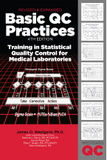

Basic QC Practices, Second Edition 2002, 340 pages $60 list price
Authors: James O. Westgard, Ph.D. with contributions from: Elsa F. Quam, BS MT(ASCP) Patricia L. Barry, BS MT(ASCP) David Plaut, Scientific Specialist Sharon S. Ehrmeyer, Ph.D. Bernard E. Statland, MD, Ph.D.
Contents:
Accredited by the ASCLS for 15 PACE credits. Accredited by the AACC for 12 ACCENT credits.
Available as an online course. Sponsored by the ASCLS for 15 PACE credits.
Thousands of laboratory professionals made the first edition of Basic QC Practices their standard reference.
In this new edition, Dr. James O. Westgard and colleagues have updated and expanded their coverage:
NEW TOPICS ADDRESSED:
NEW DISCUSSIONS:
Now more than ever, Basic QC Practices is the gold standard for learning Quality Control: a concise and comprehensive introduction to the backbone of the laboratory -- statistical quality control. For healthcare pratictioners who want to implement and operate valid QC procedures, this manual is an essential reference.
Basic QC Practices, Second Edition teaches you how to:
Back to top
CLMA, November/December 1998 Clinical Biochemist Newsletter, March 1999 Clinical Laboratory Science, March/April 1999 Clinical Chemistry, June 1999 Am. J. Clin. Path., April 2000
A resource for training laboratory and point-of-care personnel to perform statistical quality control, Basic QC Practices counteracts the notion that if something does not seem broken, why fix it. The assumptions that test results are satisfactory and processes adequate do disservice to the patients and physicians served by laboratorians. Automated instrumentation and high-tech information systems do not in themselves ensure test quality. Laboratorians need proactively and continually to assess quality control.
The text is divided into concise lessons with learning objectives and activities designed to reinforce basic concepts. The required reading (included) addresses each topic in reader-friendly language and includes charts, diagrams, and graphs. In addition to relevant statistical information, instruction and interpretation, the book incorporates the application of regulatory matters to quality control practices, helping managers understand, as well as perform, the procedures necessary to achieving their quality goals.
The book is unique in that the lessons were published first on the Internet, and the materials still can be accessed at http://www.westgard.com. CLMA members can take special note: one of the acknowledged contributors is Sharon Ehrmeyer, Ph.D., a frequent presenter at CLMA annual conferences. Dr. Ehrmeyer covers the government angle by providing information gleaned from the Federal Register on the latest regulations and their role in quality control. She discusses HCFA, CLIA, and JCAHO requirements for QC, focusing on HCFA's requirements on test complexity, waived testing provider-performed microscopy, as well as CAP's and JCAHO's stipulations. A basic QC glossary and a section of frequently-asked-questions round out the series of lessons, bringing the overwhelming idea of quality to a more manageable level.
The main author of this book, James Westgard, needs no introduction to most clinical biochemists as we are all very familiar with the Westgard Rules. OK, but are we all as aware of the basics of quality control practice.? This book seeks to help us understand the basics of quality control and train us in its use.
Before Basic QC Practices was produced in book form it was first published on the Internet. Literally thousands of people have had the chance to preview many of the chapters in the book. In fact, all the material in the book can be found posted on http://www.westgard.com along with other material on QC planning and method evaluation.
This 238-page book takes the reader through the whole spectrum of basic quality control practices, from the idea behind statistical quality control through the interpretation of quality control, ending with the process for establishing quality control procedures. This is done in 12 chapters that are formatted in a tutorial style. Each chapter lists its objectives, followed by the lesson material and then a list of things to do. At the end of each chapter is the usual list of references to published material and also a list of on-line references where the reader can find additional information on the Internet.
Taking chapter 11 as an example. This chapter asks, "What's the overall process for establishing a QC procedure?" Th objectives of the chapter are to:
The lesson material consists of written lectures:
Then follows the things to do:
The other 11 chapters follow a similar format. The 3 authors write most lessons in each chapter but there are lessons written by Sharon Ehrymeyer and Bernard Statland in the book.
Appendix chapters at the rear of the book introduce us to OPSpecs charts, which are practical maps for guiding laboratories to defined quality destinations. You will need to read about it in the book to learn more!
The book is written in a very user-friendly manner, and at times you may feel that the authors are sitting beside you, guiding you through the lessons. We learn that Mrs Westgard's Rules controls the Westgard household and these are the rules that have kept Dr Westgard under stable control for many years.
This is not a book of boring statistics or, at least where boring statistics do appear they are treated in a way that makes them easy to understand. I particularly enjoyed James Westgard's non-technical description of the multi-rule QC procedure. He says, "When my daughter Kristin was young and living at home, she liked to party. One day when she told me she was again intending to be out late, I felt the need to exert some parental control over her hours. So I told her that if she was out once after three o'clock, twice after two o'clock or four times after one o'clock, she was in big trouble. That's multirule control".
The book is American and contains a chapter on the regulatory and accreditation guidelines that influence the practice of QC in the USA. Although these guidelines are not applicable to Australia it does give us a chance to compare and contrast the laboratory regulations of the two countries.
Basic QC Practices is an introduction to the backbone of the laboratory, which is statistical quality control. It is an ideal reference material for those who want to implement and operate valid QC procedures in central laboratories or point of care testing settings. With its links to the Internet it is an ideal resource for those studying for higher qualifications such as the MAACB. I enjoyed working through the book and visiting the Internet references. Books on quality control can be boring, this is not one such book.
The book is also available in CD format and as an on-line education course.
Kolb's Theory of Learning Styles asserts that students display different learning styles or preferences. Westgard's Basic QC Practices complements this theory by providing three different ways to study or review information on quality control practices. The content in all three media is almost identical, but is presented in a different format in each:
With the information accessible in three formats, these lessons can be available to students with different learning preferences, to learners with different computer skills, and to laboratory personnel with different forms of Web access. In a classroom setting where computers and the Web are readily available, however, the instructor may want to push the students into using the most technologically advanced format and assign the CD where the program simulates surfing the Internet or use the Web format itself.
The lessons included in the package cover the following topics: regulatory guidelines, characteristics of control materials, calculations, plotting and interpreting results on a Levy-Jennings chart, Westgard's multirule QC system, solving out-of-control situations, documentation procedures, and guidelines for establishing QC procedures.
Each lesson is formatted similarly beginning with a goal statement, followed by cognitive objectives, the lesson materials, and things to do. For example, Chapter 2, "What's the idea behind statistical quality control?" begins with the statement: "Learn to describe the basic idea of statistical QC in terms of the variation expected in a measurement process". In "QC-The Idea", Dr. Westgard shows how a histogram representing measurement variation is the basis for the QC chart. The objectives for the chpater are: explain the basis of a statistical QC chart, review the QC terminology, and preview the application of QC for laboratory tests. The "things to do" include: study the lesson select an example laboratory test that is of interest to you, and review your laboratory's description for doing QC for this test.
Each lesson consists of five to ten pages of text to study and is followed with online references, references, and several self-assessment quations. The self-assessment questions cover the stated objectives. For example, "What is the basic principle of statistical QC?" and "What is a control rule?" are two of the questions asked for Chapter 2. Each lesson is meant to take two to three hours of study and work before moving on to the next chapter.
The first eight chapters could easily be used for beginning clinical laboratory science students. They could follow this section with practice identifying "in-control" and "out-of-control" situations through actual performance of laboratory tests or in pencil-and-paper practice problems. Lesson 9 to 11 would follow.
The eleven lessons are followed with frequently-asked-questions (FAQs), an excellent glossary, a comprehensive list of references used in the lessons, and the answers to the self-assessment questions. The appendix includes lessons that would be considered more advanced: "Quality Requirements", "Mapping the Road to Analytical Quality with OPSpecs Charts", "Normalized OPSpecs Charts", and "Total QC Strategies".
Westgard's unit on Basic QC Practices can be used easily by the beginning clinical laboratory science student as well as by the practiced clinical laboratory scientist who needs to review the concepts of quality control. With the variety of formats that can be used to access the material, learners can find the format that best suits their preferred way to learn the material.
This extremely readable book delivers what it promises, and more. Its user-friendly style is undoubtedly the result of its origin as a series of documents published on the Internet before it was reorganized into a traditional text. One can find all of the materials contained in Basic QC Practices, in somewhat different order, at the www.westgard.com website. For anyone with access to the Internet, this truly offers a "try before you buy" opportunity.
Written in the easy style of a transcription of a lecture, the text thoroughly covers both the theory and the practice of quality control (QC) in a clinical laboratory. Westgard draws on his years of analyzing QC processes to produce a text with a strong practical focus. The first six chapters would serve well as the basis for lectures to medical technology students, covering the "Why" as well as the "How" of QC. Requirements imposed by CLIA, the Joinnt Commission on Accreditation of Healthcare Organizations, and the College of American Pathologists, as well as medical decision issues, are all included. Its educational style is reinforced by the consistent inclusion in each chapter of "Objectives", "Outlines", and "Self Assessments". Also included are extensive references to printed works as well as Internet sources, a glossary, and flowcharts for development of a QC process well grounded in theory.
The title of the book, referring to "basic" practices, is most applicable to the initial chapters. The remaining two-thirds of the text discusses at a more advanced level the probability of random and systematic error detection, of correctly recognizing process control, and of false rejection of a run in control. Despite the inclusion of the theoretical foundations of process control, the text retains its "How To" approach by organizing sections in a chapter around practical questions that arise in routine laboratory operations. Sample forms and procedures are offered as well as practical discussions of real-world problems. The use of various portions of th etext would be invaluable in drafting, expanding, or refining a laboratory's QC policies.
At times, the focus on statistical concepts obscures the overall purpose of the QC program. For example, despite several admonitions that a total QC process includs consideration of the clinical requirements of the testing process, Chapters 7, 8, and 9 emphasize the statistical tools so strongly that it is easy to overlook the basic purpose of the entire QC program: to ensure an adequate, defined level of accuracy. At one point, Westgard compares the QC process to a diagnostic test. Remembering that the purpose of the QC process is to tell the analyst whether the testing process is "healthy" is an important insight not often stressed in other QC treatises.
In summary, this book deserves a place on the clinical laboratory scientist's shelf. It is a refreshing blend of theory and practical advice that is useful for teaching, for review, and for everyday laboratory operations.
By Dr. John Olson, Am J Clin Pathol April 2000:113
More than a year ago, I had an opportunity to review quality control (QC) practices with residents in a training program. The format for this review was a digital projector and access to the Web site of the Westgard Quality Corporation. During our sessions using the Web site, we had the opportunity to review basic QC practices, the multirule procedure ["Westgard rules"], and planning processes for the QC of individual analytes. This Web tool has been a useful training and reference tool for me and was very well received by the residents in the program.
....Dr. Westgard and his coauthors have now extracted the material...from the Web site and published a useful paperback book encompassing basic QC practices. I am personally pleased to see this volume....
This text compiles basic QC principles into a single volume. It will be a useful text for the training of technologists and residents in pathology for the development of QC procedures in the laboratory. The text is also a good resource for nursing and other services that struggle with control in point-of-care testing. The text explains the way that appropriate planning of the QC process and the application of QC rules can detect varying types of analytical error. It can be helpful both in improving the quality of testing in the laboratory by reducing the detection of false errors and in increasing the probability that true errors will be detected.
The book has 12 chapters with 4 appendices and is well referenced. The book is organized into 3 sections: (1) QC Basic Training 101, in which the principles and practice of QC are discussed in some detail; (2) QC Basic Training 102, in which control materials, calculations, the multirule procedures, and the interpretation of multirule procedures are discussed; and (3) QC Basic Training 103, in which regulations, medical decision levels, probabilities of rejection, record-keeping, out-of-control problems, and the planning process are reviewed for supervisors and laboratory directors....
The book, the CD-ROM version that is also available, and the accompanying Web site (www.westgard.com) have provided a solid, back-to-basics approach to QC and have taken a perceived confusion and difficulty of multirule QC to a level of orderly basic understanding. The text contains the information that should be required study for any student of laboratory medicine and should be available for reference in clinical laboratories dealing with QC. When teaching medical technology students, residents of clinical pathology, and others, it is always emphasized that medical instruments are designed to fail; that anytime technologists or clinicians approach an instrument to perform an analysis, they must assume that since the last time the instrument was used, a malfunction has occurred; and that the instrument must demonstrate that it is functioning properly and capable of generating data within control limits. This book tells them how.
Try before you buy! You can now download the first part of the book as a Portable Document Files (*.PDF). Simply fill out the form below and press the submit button. Then you will see a link to the PDF file. You will need special software -- The free Adobe Acrobat Reader -- in order to view it.
If you already have the Adobe Acrobat Reader: The program should launch automatically and allow you to view the pages as you download them. If the Acrobat Reader doesn't launch automatically, make a note to remember where the pages are stored on your hard drive when you download them, and after you've finished downloading, launch the Acrobat Reader separately and direct it to the downloaded pages on your hard drive.
If you don't have the Adobe Acrobat Viewer: You can get it for free! Simply click on the icon to visit the Adobe Acrobat website and download and install the Reader on your computer. Then follow the instructions above.