
Method Validation
Myths of Quality
We like to assume that everything works perfectly in today's healthcare laboratory; that analytical quality is a given; that even if we don't know what quality we need to achieve, we're achieving it; that today's methods have better imprecision and inaccuracy than needed; that no further improvements are necessary in the QC of the 21st century. Dr. Westgard discusses these myths, sorting fact from fiction, and providing commentaries. (Preview)
A MYTH is a Mistaken Yarn, Theory, or Hypothesis!
- Historical myths of cartography:
- Mythical island of California
- Mythical island of Friesland
- Mythical islands in Lake Superior
- Modern myths of quality:
- QA assures quality in healthcare
- Statistical QC controls the quality of laboratory tests.
- Quality can be managed even if the required quality isn't known.
- Quality requirements need to consider only imprecision and inaccuracy.
- Current methods have better imprecision and inaccuracy than needed.
- Analytical quality is a given today.
- No further improvements in analytical quality are needed.
- Need for quantitative management of analytical quality
 Historical Myths of Cartography
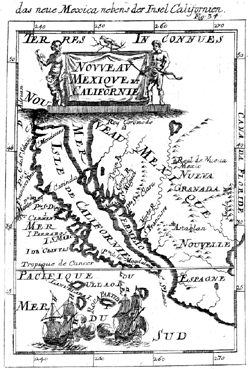
Mythical island of California.
Did you know that California was an island? It's well documented on the most reputable maps of the 1600s that California was completely surrounded by water. For example, see the accompanying map that shows the Isle de Californie. There it is, documented in black and white, proof that California was an island.
This map of Nouveau Mexique et Californie by Alain Mallet was published in 1683 in the Description de l'Univers (Paris). Mallet copied the flat-topped model of California that appeared in an earlier map by Sanson, who was one of the most distinguished French cartographers. It was very common for mapmakers to copy each other's work. When a new discovery appeared on one map, it was widely disseminated on many of the maps of the time. The discovery that California was an island was first documented in 1622 and persisted on maps as late as 1750, even though evidence in 1705 clearly established that this was a myth.
Actually, there is quite a history of mythical islands, suggesting that these myths are not as rare as you might expect. In the late 1500s, one of the most famous mapmakers, Abraham Ortelius, prepared a map of the Northern Atlantic that showed an island of Friesland lying a bit west and south of Iceland, complete with a detailed description of the coastline, the harbors, the people who lived there, what they looked like, and what they did for a living. The Ortelius map is beautiful, decorated with sailing ships and sea creatures, and was the most authoritative map of the area at that time. The only problem was that Friesland didn't exist. When people sailed to the new world and passed Iceland, they ascribed more and more details and reality to Friesland because they expected it was the next body of land.
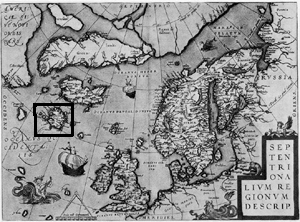 At left: Septentrionalium regionum descrip. Abraham Ortelius, 1575. A box shows where the fictional island lying below greenland and iceland.
Below: a detail of the island, including cities and harbors.

Mythical Islands in Lake Superior
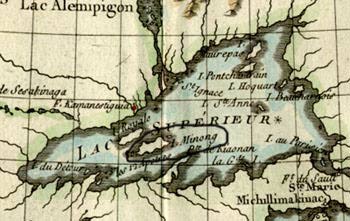 Another example that is of interest to those of us in the Midwest are the Isles of Phillipeaux and Pontchartrain in Lake Superior. When the border between the U.S. and Canada was settled by the Treaty of Paris in 1783, it was decided that these islands would be part of the U.S. (The map shown here is from 1780 by the cartographer Bonne documents the existence of these islands, though it uses the name Minong instead of Phillipeaux for the island in the southern or bottom part of Lake Superior.) In the early 1800s when Wisconsin was being settled, the U.S. government sent out surveyors to map this area more completely, but they couldn't find these islands! They showed up on all the maps of the time, but they didn't show up above the water. It seems that that the explorers created these islands and named them after the government minister who was funding their investigations. They probably needed some preliminary findings to justify getting more money for further explorations, somewhat akin to the process of obtaining research funding today.
Modern myths of Quality
These myths are amusing in retrospect, but they were taken very seriously at the time and caused some serious problems later on. There are myths today about quality that are also taken very seriously and will cause us serious problems in the future. Some of them hit very close to home - the quality of healthcare and the quality of laboratory testing.
Myth #1: Quality Assurance assures quality in healthcare
It's a mistaken yarn that puts a good spin on current efforts to measure the quality of healthcare. As healthcare providers, we all talk about quality assurance (QA), but our quality assurance programs (which are often required by regulation and accreditation) primarily deal with measuring performance. Quality Assessment would be a better name for these efforts. While it is important to assess quality to know how well we're doing, measuring quality doesn't assure that the necessary quality will be achieved. Achieving quality actually requires quality planning, which starts with defining the quality that is needed, then builds that quality into the process.

We invite you to read the rest of this article.
This article, plus many more important, updated, and expanded chapters are available in the Basic Method Validation manual, 3rd Edition which is available at our online store. You can download the Table of Contents and other chapters here. You can also enroll in the Basic Method Validation course and access the new materials online.