
Think straight, Talk straight
Do what's right, and Do it right!

James O. Westgard

A word from
Dr. Westgard
 

January 23rd, 2004
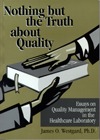
An updated version of this essay appears in the Nothing but the Truth about Quality manual

James O. Westgard, PhD, FACB

Today’s world is oriented to money and the bottom line, and we are seeing the impact of this business orientation in healthcare as well. By making healthcare into a business, we have also tapped into the pervading business ethics, or the lack thereof. Healthcare and its surrounding industries have also become focused first on making money and secondly on providing quality treatments and services for our patients. If you doubt that statement, just look at the similarities between the fraudulent activities of HealthSouth and Enron. Officers of both corporations are under indictment and prosecution.

I have been fascinated with the story of Enron, the 7th largest company in the United States, the darling of the Wall Street in the nineties, the vanguard of new business practices, the “coolest company in the world” according to its employees, and the largest bankruptcy ever when it filed for Chapter 11 protection on December 2, 2001. Most of my pleasure reading is devoted to mysteries, but I have found myself reading books on Enron [1-3] and its co-conspirators such as Arthur Andersen [4-5]. These books are mysteries in their own right – real-life mysteries that are much more complex and intriguing than fiction.

Mysterious profits

I’m sure this discussion is an over-simplification of what happened at Enron, but after all my reading here are some of the smoking guns.

Enron never was on sound financial footing once it launched its power trading operation with its mark-to-market accounting. That was the way Jeffery Skilling built the company in the mid to late 1990s. Skilling went on to become CEO of Enron and changed the company from “hard assets” to “light assets”, meaning intellectual capital instead of owning gas supplies, gas lines, and physical assets. Skilling resigned a few months before Enron collapsed and to this day professes there was nothing wrong with the company when he left.

While I don’t pretend to understand mark-to-market accounting, I do know that when you make a long-term contract you don’t have any money until the contract is implemented and executed. Enron’s power deals went 15 to 20 years into the future, but they booked all the income the day the contract was signed. That looked good on the income statements, which of course looked good to the Wall Street analysts who then hyped the price of the stock, which increased the value of the company. The guys who did the deals were paid bonuses immediately based on those expected long-term profits. Making deals was how to make money; delivering on the deals was never a priority.

So the deal-makers made big money, millions in bonuses and millions in stock options. Likewise, the company executives made big money, millions in bonuses and millions in stock options. And the banks made big money and the accountants made big money and the stock analysts made big money and Wall Street was happy and the stock price continued to increase!

The employees who had to implement the deals didn’t make big money, but they bought Enron stock and would have made good money if the price of the stock hadn’t tanked. However, some of the employees were unhappy that they weren’t getting the bonuses made by the deal-makers. One happened to be Andrew Fastow, who at the time of this writing just agreed to a plea bargain.

January 15, 2004 HOUSTON (AP) – Andrew Fastow, chief architect of the off-the books deals that brought down Enron, pleaded guilty along with his wife Wednesday in a deal that could take prosecutors to the top of the corporate ladder at the scandal-ridden company.

“The former finance chief agreed to a 10-year prison sentence and will help prosecutors build a case against the executives who once occupied the most opulent offices on the company’s top floor: former chairman Kenneth Lay and former CEO Jeffrey Skilling.

‘I and other members of Enron senior management fraudulently manipulated Enron’s publicly reported financial results,’ Fastow said in a statement filed with the plea agreement, adding that the purpose was to mislead investors and inflate the company’s stock price and credit rating.”
Special purpose effrontery

While the first part of the deception had to do with booking all the profits upfront with mark-to-market accounting, that wasn’t enough to keep the income statements looking good from quarter to quarter. Enron had to acquire some hard assets to make the deals work. That meant borrowing money to buy other companies. That’s debt – a dirty word on Wall Street. Debt affects your credit rating and Enron’s credit rating was critical for its trading business.

Here’s where Fastow became the financial savior for Enron. He devised ways to utilize SPE’s (Special Purpose Entities) to both reduce debt and improve income. Sounds impossible, doesn’t it? It’s like buying a new home, transferring the title to a partner in which you have 97% ownership (by pledging the value of the home), removing the mortgage debt from your books, and booking the sale of the home as a profit (even though you sold it to your SPE-self). Doing this allows you to acquire the new home and include all the gain but none of the loan in the value of your estate. That’s financial magic, isn’t it! That’s also effrontery – flagrant disregard of propriety and an arrogant assumption of privilege!

The catch was that the SPE’s required at least 3% of the capital come from an outside independent investor. To facilitate access to an outside independent investor, Fastow himself became the investor. Independent and outside? No, but the Skilling, Lay, and the Enron Board of Directors approved Fastow’s role and also gave an exception to the conflict of interest policy and the conflict that would arise when Fastow sold Enron’s assets to Fastow’s SPEs.

While Fastow claimed he was only spending 3 hours a week on the SPE’s behalf, records show he made in the neighborhood of $65 million dollars from these partnerships during a three year period. Nice work if you can get it!

He also involved a few other Enron officials and employees in these transactions, probably to co-opt them by making them part of the deals. For example, one Enron lawyer who was involved in reviewing the deals became an investor and made $1,000,000 on a two-month investment of $5,800. Most anyone could be co-opted for that kind of a return. Fastow and his right hand man (Kopper) each made $4,500,000 in the same deal based on their investments of $25,000. In comparison, Martha Stewart is a saint and should be ashamed for getting indicted on misbehavior that brought a profit of only tens of thousands of dollars!

Fastow had become a deal-maker and was reaping the same benefits as the other deal-makers at Enron. And his deals were now critical for removing debt and booking income. Of course, all of these partnerships depended on Enron’s stock maintaining a healthy price. If the stock fell below certain triggers, then the debt returned to Enron’s books. Fastow’s SPE’s were off the hook for everything but profits.

What happened, of course, was that some “short-sellers” began to understand that Enron was only a paper tiger, others also began to question Enron’s profit statements and cash flow, Enron’s stock price started to decline, banks and analysts become wary, and the stock price further declined and ultimately collapsed. All the debt returned to Enron’s books; the mark-to-market accounting turned out to be frivolous because there was no cash-flow; the hard assets were minimal and over-valued; and Enron had to declare bankruptcy.

Who’s responsible?

The most detailed analysis of the Enron debacle is the book authored by two senior writers at Fortune who spent 16 months of intensive investigation of the story [3]. In their final chapter, they pose the question “Isn’t Anybody Sorry?” The answer is that no one feels responsible for what happened. Everyone believes that everything they did was within the letter of the law. As McLean and Elkind put it:

“The after-the-fact rationalizations were strikingly similar to the mind-set that brought about the Enron scandal in the first place. All the arguments were narrow and rules based, legalistic in the hairsplitting sense of the word. Some were even arguably true – in the way that Enron itself defined truth. The larger message was that the wealth and power enjoyed by those at the top of the heap in corporate America – accountants, bankers, executives, lawyers, and members of corporate boards – demand no sense of broader responsibility. To accept these arguments is to embrace the notion that ethical behavior requires nothing more than avoiding the explicitly illegal, that refusing to see the bad things happening in front of you makes you innocent, and that telling the truth is the same thing as making sure that no one can prove you lied.”

If that sounds like the compliance mentality that is rampant in healthcare today, you're starting to see the connection. Truth and quality are closely related and both suffer in the current times with the current values and the current business practices.

We have lost many of the values that have been important in the history of our country and our democratic society. No where is that more clear than with Arthur Andersen – a revered name in the accounting industry, a name that stood for honesty and integrity, a Midwestern firm that had Midwestern values, founded in 1913 by a Northwestern accounting professor who was the son of Norwegian immigrants, who’s mother always told him to “think straight, talk straight” [5]. And he adhered to that principle to the point of dismissing client firms that attempted to provide deceptive earnings statements and audit reports, once telling a client “there is not enough money in the city of Chicago to induce me to change this report.”

Old fashioned values - such as truth, honesty, integrity, hard work, and just and equitable treatment for all - must become the new fashion in business and healthcare to guide us to a new and better future. As providers of healthcare, we must take care of the quality of our services. If we don’t, no one else can! If we won’t, then we cannot expect quality care for ourselves and our loved ones! We must think straight, talk straight, do what’s right, and do it right!

References

  1. Fox L. Enron: The Rise and Fall. John Wiley & Sons, Inc., Hoboken, NJ, 2002.
  2. Swartz M and Watkins S. Power Failure: The Inside Story of the Collapse of Enron.Doubleday, New York, 2003.
  3. McLean B and Elkind P. The Smartest Guys in the Room: The amazing rise and scandalous fall of Enron. Portfolio, Published by the Penguin Group, New York, 2003.
  4. Toffler BL and Reinbold J. Final Accounting: Ambitions, Greed, and the Fall of Arthur Andersen. Broadway Books, New York, 2003.
  5. Squires SE, Smith CJ, McDougall L and Yeack WR. Inside Arthur Andersen: Shifting values, unexpected consequences. Prentice Hall Financial Times, Upper Saddle River, NJ, 2003.


James O. Westgard, PhD, is a professor of pathology and laboratory medicine at the University of Wisconsin Medical School, Madison. He also is president of Westgard QC, Inc., (Madison, Wis.) which provides tools, technology, and training for laboratory quality management.

Other Essays:

Copyright © 2004. All rights reserved.
Westgard QC, 7614 Gray Fox Trail, Madison WI 53717
Call 608-833-4718 or e-mail us at westgard@westgard.com
A Message from JOW
QC Lessons | QC Applications | Questions | Multirule
CLIA Requirements | What's New?| Catalog | Demo Download
Home  | Glossary | ARCHIVES | Links | Feedback