
Sigma Metric Analysis
An Automated Urit 5160 in Bambili Cameroon
Here's a hematology instrument we haven't heard about before: Automated Urit 5160. How does it perform? A recent study from Bamenda Regional Hospital, Bambili, Cameroon has the data.
An Automated Urit 5160 Hematology Analyzer in Brambili, Cameroon
August 2026
Sten Westgard, MS
[Sigma score: long-term imprecision: +0.5; controls near decision points: +0.5; 3rd-party controls: + 0.5; Bias using patient samples: +0.5. Final Score: 2. Optimistic quality data. ]
A recent study looked at hematology analzyer we have not previously encountered, from the Bamenda Regional Hospital, Brambili, Cameroon:
Victor N Fondoh, Loveline L Niba, Mary B Atanga, Performance Evaluation of Automated Urit 5160 Haematology Analyser at the Bamenda Regional Hospital, Cameroon. Journal of Clinical Laboratory Analysis, 2026; 40:e70256 https://doi.org/10.1002/jcla.70256
We're going to apply the CLIA 2025 quality goals to the top 5 hematology parameters and see the analytical Sigma metrics.
Calculating Sigma metrics from routine laboratory performance data.
The imprecision and bias of the analyzers
Both within-run and between-run precision studies were run. "The between-run experiments were analysed using commercial control specimens (Eurocell Diagnostics, Rennes Cedex, France)...The specimens were run in duplicate for 20 conservative [stet.] days." It's safe to assume the authors meant consecutive days, not conservative days.
Bias was assessed "by comparing the instrument under verification - Urit 5160 with a Urit 3000 plus - three-part auto-analyser already in use in the laboratory. One hundred patient specimens, within the relevant clinical range (normal and pathological) werer run in paralell on both the Urit 3000 plus and Urit 5160 for all parameters. Specimens were analysed on both instruments within 15 minutes."
TEa goals were taken from CLIA 2025.
Here are the Sigma metrics for the Urit 5160:
| Urit 5160 Cameroon | % Bias | % CV | Sigma-metrics |
| Hemoglobin | 0.00 | 1.50 | 2.66 |
| Hemoglobin | 0.00 | 3.09 | 1.29 |
| Hemoglobin | 0.00 | 1.17 | 3.42 |
| Hematocrit | 3.34 | 1.59 | 0.41 |
| Hematocrit | 2.21 | 1.08 | 1.66 |
| Hematocrit | 1.96 | 1.51 | 1.35 |
| Platelets | 0.00 | 3.66 | 6.83 |
| Platelets | 0.00 | 1.70 | 14.66 |
| Platelets | 0.00 | 2.36 | 10.61 |
| RBC | 0.00 | 2.09 | 1.91 |
| RBC | 0.00 | 0.81 | 4.95 |
| RBC | 0.00 | 1.47 | 2.73 |
| WBC | 0.00 | 2.23 | 4.48 |
| WBC | 0.00 | 1.81 | 5.53 |
| WBC | 0.00 | 1.60 | 6.27 |
While platelets and WBC are in good shape, but the other parameters are not looking good.
Graphic illustration of analytical performance by NMEDx chart
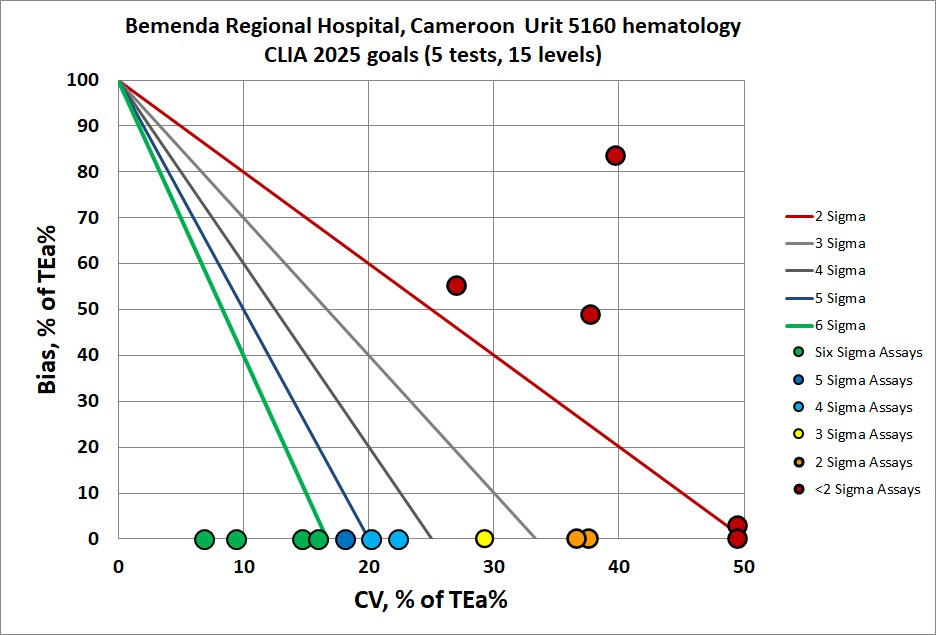
The bias is indeed low for most parameters, which is not too surprising: two models from the same brand are being compared in the same laboratory. But having minimal bias is not enough; imprecision must also be low in order ot hit the demanding CLIA 2025 goals. Instead, some of the imprecision is literally "off the charts."
Conclusion
The authors concluded, "The performance of the Urit 5160 Haematology auto-analyser demonstrated acceptable blank count, imprecision, carryover, and linearity against the manufacturer-provided specifications and excellent agreement with minimal bias and narrow limits of agreement within the constraints of the comparator instrument....Thus, the instrument is suitable for use to improve workflow, pateint management, and research."
Unfortunately, the authors made this conclusion after using the 1992 CLIA goals. When we applied the 2025 CLIA goals, performance was not acceptable for many assays. In a study published in 2026, authors and journals need to insist on using the CLIA goals from this century, not the last.
A point can be made that in Cameroon, CLIA goals are a choice, not a mandate. If the authors made an explicit defense for using the goals of more than three decades ago, that might provide a justification for their conclusion. But the study shows no sign of any awareness of the 2025 goals.
This is yet another study showing that hematology instruments have a difficult time achieving good quality against the CLIA 2025 benchmarks. If one were going to justify using CLIA 1992 goals, it might be helpful to assemble a series of analyses that show few, if any, of today's hematology methods can hit the new goals.