
Sigma Metric Analysis
An Abbott CELL-DYN Ruby in Mangalagiri, India
In 2025, An AIIMS study assessed the performance of an Abbott CELL-DYN Ruby hematology analyzer. This unique study not only assessed the instrument performance, it assessed the performance of the quality specifications themselves. Which goals are most appropriate for hematology analyzers today?
Abbott CELL-DYN Ruby hematology analyzer in Mangalagiri, India
Sten Westgard, MS
February 2026
Sigma Score 3.5 out of 6. Moderate. [Application of BV goals (as well as others); long-term estimates of both CV and Bias; bias vs EQAS peer; 3rd party controls.]
This study is unique in that it not only assess the performance of an instrument, but it attempted to assess the performance of the performance goals used to measure the instrument.
Redefining quality targets: a first-time application of an innovative graphic tool in hematology using six sigma. Poongodi Rajagopal, Arundhathi S, Jyotsna Naresh Bharti, Suneel Racha giri, Ragavendran Paramasivam. Scandinavian Journal of Clinical and Laboratory Investigation. https://doi.org/10.1080/00365513.2025.2592228
The Imprecision and Bias data
"This retrospective observational study was conducted in the hematology section of a clinical laboratory. IQC and EQAS data were collected for 12 consecutive months (January-December 2024). CV% was calculated from monthly IQC data pooled over this 12-month period, while Absolute Bias was derived from corresponding monthly EQAS cycles coverin the same duration." Bio-Rad controls and EQA program were used.
QC was run at three levels, so there are 3 levels of imprecision. Bias was estimated over the whole EQAS period, so there is only 1 bias estimation.
| Abbott CELL-DYN Ruby in India | |||||
| Analyte | %Bias | % CV level 1 | % CV level 2 | % CV level 3 | |
| WBC | 3.04% | 1.755% | 2.22% | 1.942% | |
| RBC | 0.72% | 1.832% | 1.707% | 1.695% | |
| Hemoglobin | 0.062% | 0.77% | 0.958% | 1.038% | |
| Hematocrit | 0.347% | 1.43% | 1.677% | 1.87% | |
| Platelet | 5.173% | 3.123% | 3.14% | 3.223% | |
In addition to calculating Sigma metrics from multiple sources, the authors make use of the Varela-Pacheco diagram, which assesses the accomplishments of Sigma metrics by those TEa goals. As they write, this is one of the first papers to ever do so.
Comprehensive evaluation of the internal and external quality control to redfeine analytical quality goals. Valera B and Pachceo G. Biochem Med (Zagreb). 2018;28(2):020710. Comprehensive evaluation of the internal and external quality control to redefine analytical quality goals - PubMed
Sigma-metrics according to EFLM-derived DESIRABLE performance specifications
As set forth by the Milan Heirarchy, performance goals based on biological variation are considered superior to those set by regulators and proficiency testing or external quality assurance programs. However, the hematology goals are known to be very demanding.
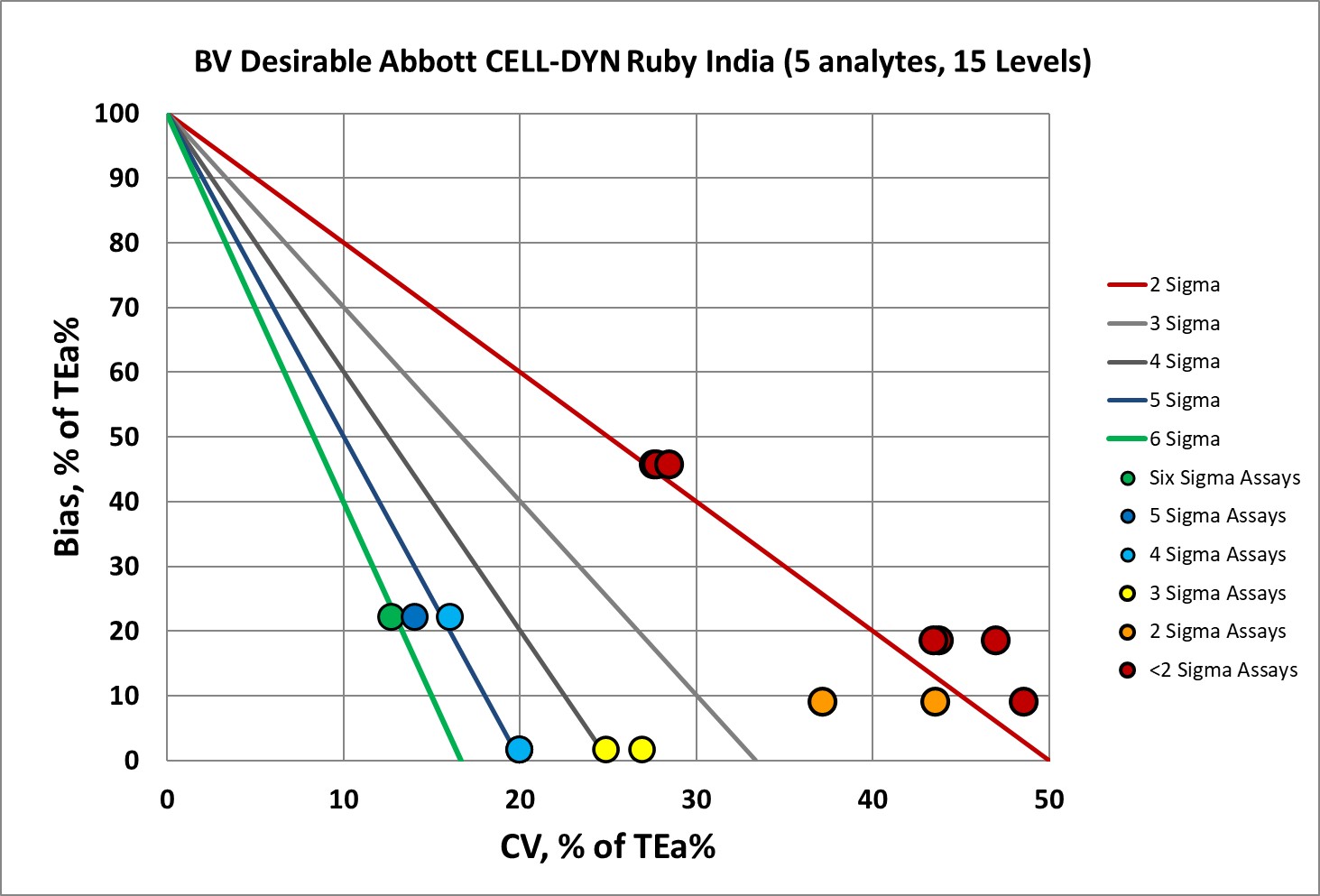
Basically, nothing hits these goals. EFLM desirable goals are now notorious for being out of reach, and clearly, with hematology, the goals live up to the reputation.
Sigma-metrics according to CLIA 2025 performance specifications
For US labs and labs that are governed by CAP accreditation, there's a respite: the EFLM biological rules aren't mandatory. CLIA 2025 goals are. One shortcoming is that the CLIA goals don't cover all the differential parameters, they only cover a few analytes, but in this case, they cover all the study parameters. The old 1992 CLIA goals were fairly forgiving, but new ones are not.
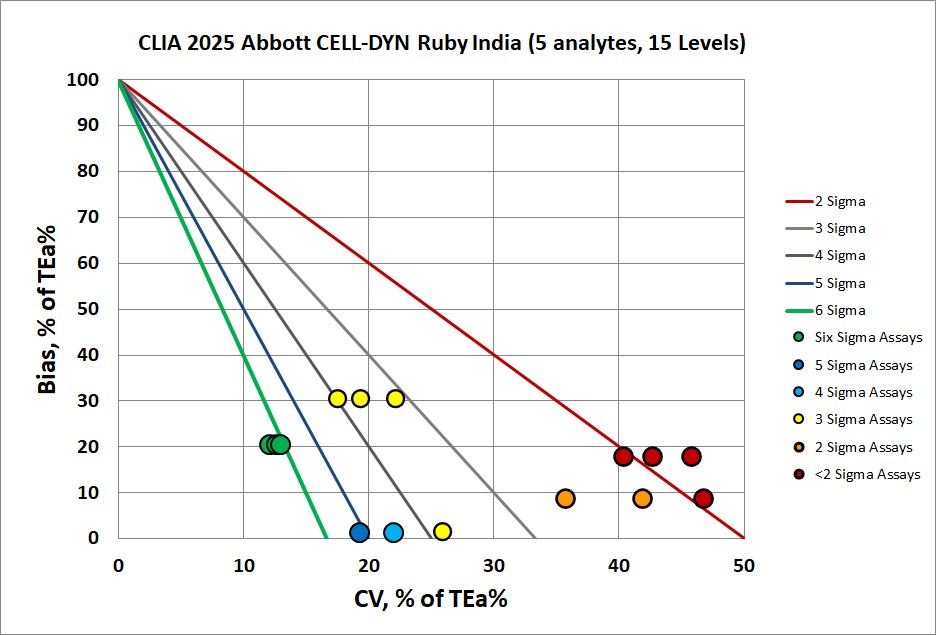
Sigma-metrics according to RCPA performance specifications
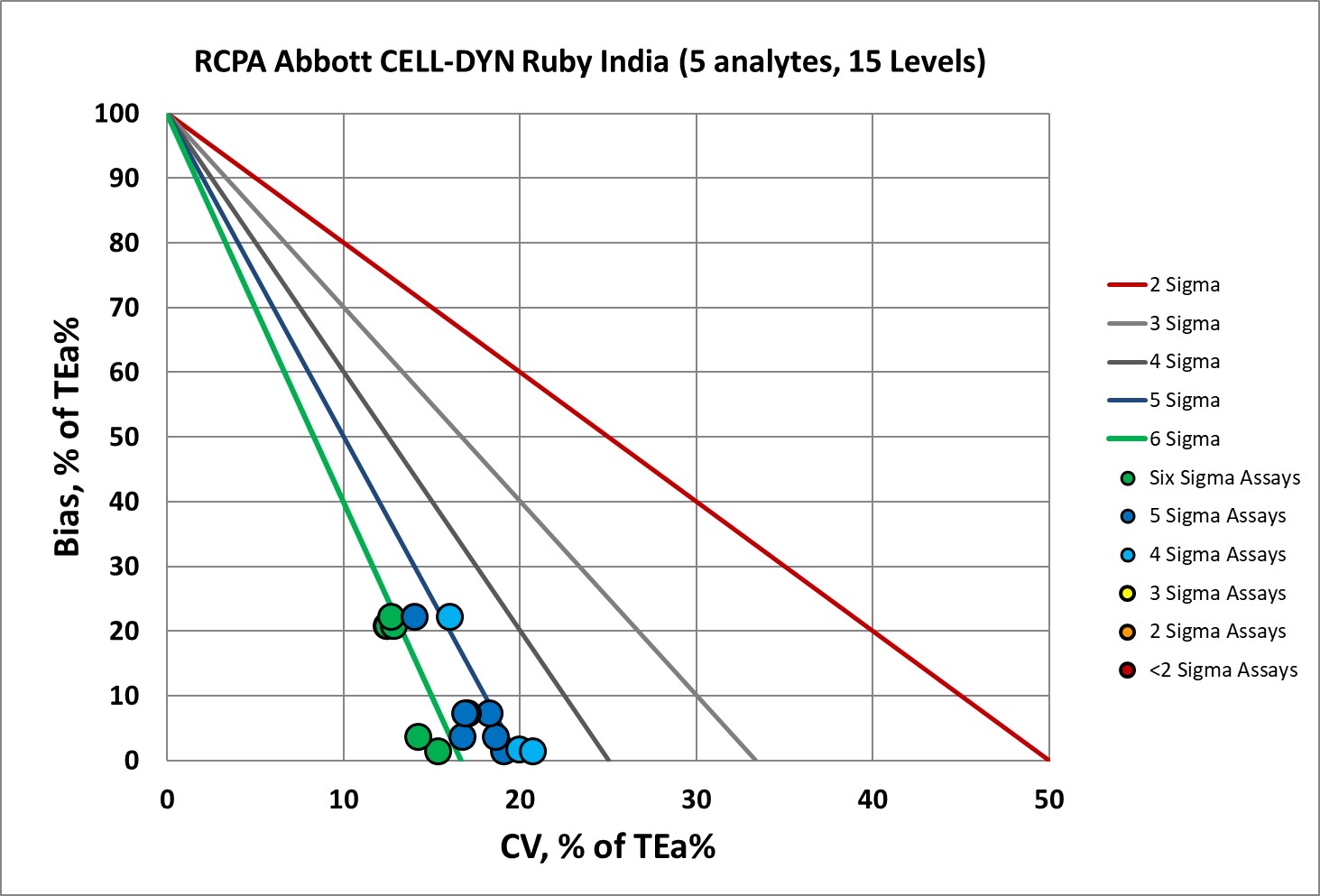
Finally, we have a set of goals that are almost completely hit by the instrument performance. In the study, the authors settle on a mixed set of appropriate goals for hematology, a mixture of mostly RCPA and CLIA specifications. Of course, it's unlikely that other parts of the world will adopt easily. CLIA doesn't allow labs to pick and choose their goals: it's all CLIA or nothing. Labs in less tightly regulated regions can pick and choose.
Conclusion
For a US lab, there are analytes here that are going to be challenging to QC and pass PT. For the same performance in an RCPA laboratory, there would be no worries. The Velera-Pacheco goal indicates that this Abbott instrument is more suitable for an RCPA environment than a CLIA one.